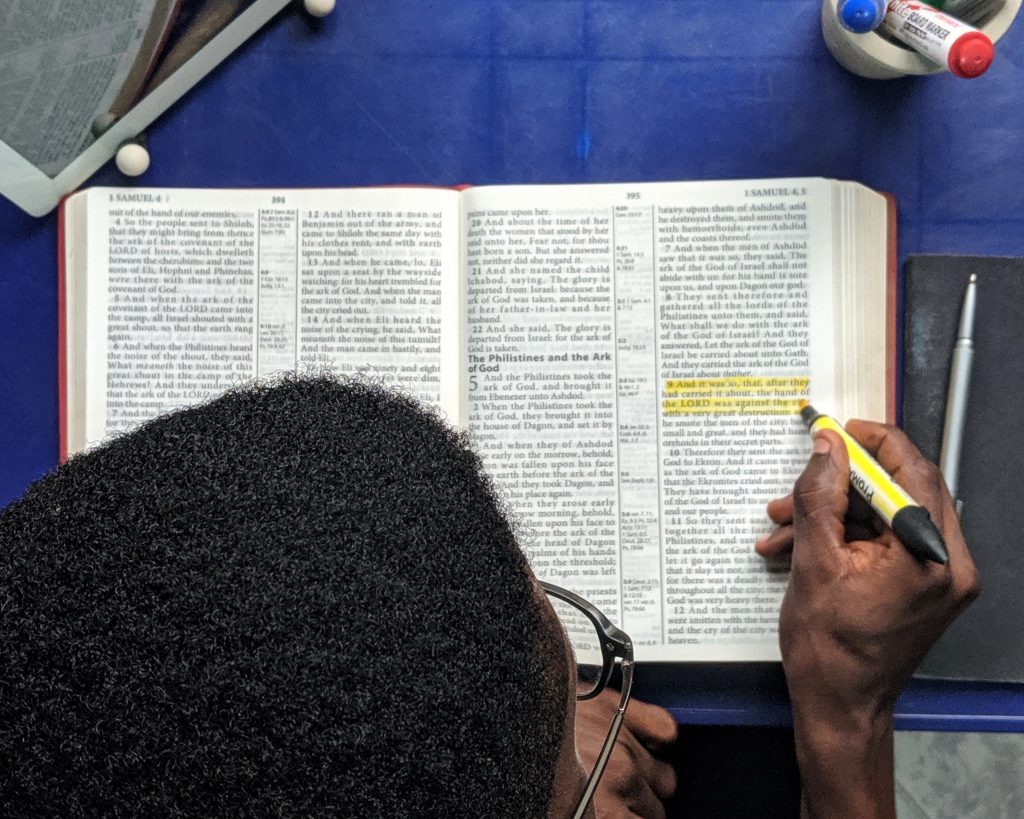
The Holy Spirit
Study Scripture: Romans 8:12 – 14, 26-27
Background Scripture: Romans 8
Lesson 4 December 27, 2025
Key Verse
The Spirit Himself testifies with our spirit that we are children of God.
Romans 8: 16
INTRODUCTION
Context is as one would expect most importance in the subject of the Holy Spirit. A study of the history of the Holy Spirit teaches us the pitfalls into which the church has fallen and this will enable us to better avoid theses pitfalls.
There have been a great deal of controversies and battles in the early church and succeeding periods in church history and so we will by study of the Scriptures get understanding of the value of life under the Holy Spirit.
There is a great deal of wisdom being imparted when we are told repeatedly that he who ignores history is destined to repeat it. So note:
“The doctrine of the Holy Spirit is a doctrine that has been plagued by the errors of men in the past, and a knowledge of the history of the subject may preserve us from some of the pitfalls”, says one writer.
The proper context of our Study Lesson rests on the Study of the doctrine of God We are told in Scripture of the Supreme Being which is called God the Father, and His work in the planning, creating, and caring for all that exists.
The highest of His creation which we call human beings strayed from His divinely intended destiny and hence terrible consequences came upon the human race.
Scripture reveal the provision that God made for their redemption and restoration.
Scriptures clearly shows creation, providence, and the provision of salvation are the objective work of God and these occur in order.
God has to apply His divine saving work to human beings which are lost by their disobedience to the divine will and instruction.
The different work of the different members of the Trinity in now to be highlighted after the work of the Father in creation and providence; the work of the Son who has brought salvation for sinful humanity, and then the Spirit applies this redemptive work to the men created by God, thus making salvation real.
It is therefore most important that we study this third Person of the Trinity and the products of His endeavours.
We therefore must pay serious attention to the significance of the Spirit’s work for the Holy Spirit becomes personal to the believer. The Holy Spirit is active in the life of the believer. In fact, He lives in us and is the God through which the Triune God works in us.
If we want to be in touch with God therefore we must become immersed in the activity of the Holy Spirit. It is through Him we are in touch with God.
It is through Him we experience God.
The Spirit works and we experience God in reality in a special tangible way.
So we must understand the Holy Spirit
It is sad that the church does not teach the brethren about the history of the views in the church of the Holy Spirit so that they can avoid the pitfalls experienced in church history.
Clearly though after the Ascension of Jesus we see that in this period the work of the Spirit is more prominent than the other members of the Trinity. The Spirit occupies center stage from the time of the Pentecost discussed in the Book of Acts and the Epistles.
In comparison the work of the Father was more prominent in the Old Testament period, the work of the Son is clearly demonstrated in the Gospels where the Son is on center stage until His ascension.
It must be made clear however that though it is important to understand the work of the Spirit it is more difficult that the Study of the Father and of the Son.
This is so because when we read about the Father and we know the figure of the Father is familiar to everyone. So we can more easily understand the role of the Father.
The Son is easy also to understand IN CONCEPT FOR He came to earth as a human being and dwelt among us and we could see Him, watch Him, and observe Him. He was a human.
But the Spirit is different in the sense it is difficult to visualize Him. He is spirit and is not tangible. In addition, we know in the translations like the King James the “Holy Spirit” is called the “Holy Ghost”, someone we think about as a “white sheet”. That might be frightening.
The nature of the Holy Spirit’s work therefore has led to men having conflicting views on the nature of the Spirit’s ministry in relation to the Father and the Son’s ministry. One writer comments on this:
“During the present era, the Spirit performs a ministry of serving the Father and Son, carrying out their will (which of course is also His). In this respect, we are reminded of the Son’s earthly ministry, during which he was subordinate in function to the Father.
Now this temporary subordination of function—the Son’s during his earthly ministry and the Spirit’s during the present era—must not lead us to draw the conclusion that there is an inferiority in essence as well. Yet in practice many of us have an unofficial theology which looks upon the Spirit as being of a lower essence than the Father and the Son…..
This essence is similar to that of the Arians. From the biblical passages which speak of the Son’s subordination to the Father during his earthly ministry, they concluded that the Son is of a lesser status and essence than is the Father”.
But the Arian view is mistaken.
In the earliest history the Spirit was the guiding and moving force that inspired the Word of God we called the Bible. It was written by the Holy Spirit. So the Scripture has no errors. Therefore in the early times little was said about the Holy Spirit.
However, the Teaching emerged that the Spirit was only an attribute of God which was called Divine Wisdom the one through whom the prophets prophesied and through whom men were made righteous.
Some believed the Spirit “was the most honourable of all the beings brought into existence through the Word, the chief in rank of all the beings originated by the Father through Christ”. Also,
“This belief that the Spirit is the highest and first of the creation is not unlike the views which the Arians were later to hold regarding the Son.”
Some like Athanasius, a prominent Teacher of the Bible, believed “the Holy Spirit is fully divine, consubstantial with the Father and the Son”.
It was only in the late second century the divinity of the Holy Spirit drew much work. There were a diversity of view. Some said the Holy Spirit was only a force.
Some said He was a creature.
Others maintained the three persons of the Trinity possess deity in varying degrees.
Some called the Macedonians or Pneumatomachians or “Spirit- Fighters opposed the doctrine of the full deity of the Holy Spirit.
Charismatic groups, the most prominent of which were the Montanists, flourished in the second century.
Their leader “at his baptism Montanus spoke in tongues and began prophesying. He declared that the Paraclete, the Holy Spirit, promised by Jesus, was giving utterance through him. Montanus and two of his female disciples as well were believed to be spokespersons of the Holy Spirit”.
One writer tells us that during the medieval period there was little emphasis on the Holy Spirit and there was disinterest in the experiential aspects of the Christian life.
The Reformation did not produce any major changes in the orthodox doctrine of the Holy Spirit. Luther taught the idea of the Holy Spirit’s “infusion of love” into the heart of the believer. He felt therefore
“The Spirit’s infusion of love pointed, on one hand, to God’s presence in the life of the individual, the results being a conformity between the will of God and the will of man. Luther’s concept also pointed to the Holy Spirit’s struggle against the old sinful nature which is still within the individual…..
Calvin insisted that the testimony of the Holy Spirit is superior to reason. It is an inward work which captures the minds of those who hear or read Scriptures, producing conviction or certainty that it is Word of God, with which they are dealing. This the second work of the Holy Spirit with respect to the Scriptures. He who had originally inspired the prophets and apostles to write the Scriptures now penetrates into our hearts convincing us that these Scriptures are indeed the work of God and thus the truth. He creates certainty, removing any doubt that we might have”.
Then men showed the great contradictory beliefs they have held about the nature and work of the Spirit.
There was scholasticism which found its inspiration in Philipp Melanchthon which as its name suggests rested on doctrinal intellectual refined beliefs where the Scriptures had a mechanical role and the witness of the Spirit tended to be bypassed.
Then there was rationalism where human reason was the supreme standard and reason would justify all the beliefs of Christianity rather than the work of the Holy Spirit. As one writer states: “Accordingly, the doctrine of the Holy Spirit who is the particular channel of God”s relating to humans, was rather neglected”.
Then there was the “romanticism” movement which in the modern era “insisted that religion is not a matter of beliefs (doctrines) or of behaviour (ethics). It is not a matter of receiving and examining doctrines delivered by an external authority. Rather, feelings constitute the essence of religion, and specifically, the feeling of absolute dependence. With this shift of the locus of religion from belief to feelings, doctrines as such tended to become lost or redefined”, says onewriter.
Note therefore that many of these movements listed, and we have only listed a few of them, resulted in the nature and work of the Holy Spirit in repentance, conversion, the new birth, and reconciliation with God being deemphasized.
In the 19th century further developments in some circles gave pre-eminence to the role of the Holy Spirit, but there were excesses which led to doctrinal divisions about the validity on the topic of the Baptism of the Holy Spirit, with one of two baptisms.
This led in some, not in all circles, to speaking in tongues or glossolalia, a practice in some quarters which was said to determine whether or not one was a real Christian.
Note the wide variety of views about the Holy Spirit from the time of the apostolic teaching. It is therefore most important that we come to understand the nature of the Holy Spirit, His person and hence His moral actions and ministries that can only be performed by a person.
The implications of the doctrine of the Holy Spirit are quite clear for as one scholar points out
First, if you believe the Holy Spirit is a person and not just a vague influence or force then He is someone with whom you must have a personal relationship. He is someone you can and should know.
Second, if you believe the Holy Spirit is completely and totally divine, you must respect and honour Him just as you would honour the Father, and you honour and respect the Son.
Third, if you would believe the Holy Spirit is one with the Father and with the Son, you would understand that His work, His way of expressing Himself, and how He does His work has been planned with the Father and with the Son and there is no tension among their persons and their activities.
Fourth, if you believe in the Holy Spirit as the Apostles taught you would know God is not far off from you. God comes close to you.
The Holy Spirit is God and He enters every believer.
He has brought to you the manifestation and fulfillment of the Promise, Immanuel, God with us.
He is intimate with you on a scale you can hardly imagine.
He is to be praised and blessed.
He is not to be grieved.
You are to submit to Him and be led by him.
He is your guarantee of eternal life.
Be warned that there are many who are unskilled in Scripture who will tell you they have visions by the Spirit which contradict His previously inspire and written Scriptures.
That is of course should make your common sense teach you that they are false.
Then you should note carefully the warning of Scripture that, By their fruits you shall know them.
There is of course much to be said on sundry matter state about the Holy Spirit. Knowledge and analysis about the many deviations in the teachings are available to those who want to learn.
In the Chapter previous to our Study Scripture the Apostle Paul had stated clearly that once a person could be classified as part of the brethren they had become dead to the law by being in the body of Christ. This union meant that they would be married to another, namely, married to Jesus Christ who has been raised from the dead.
We can never forget therefore that the church or the congregation of God is the bride of Christ with all the marvellous blessings that that union entails.
Clearly, faith in the work that Christ at done on the Cross is indispensable to salvation and if one did not believe in the efficacy of that work done the Cross by the Lord Jesus Christ they could not be part of the brethren.
This of course means that the whole purpose of the existence of the brethren was to be in union with Christ. They are clearly therefore now part of His body.
The purpose of that union was that they would bring fruit unto God.
This of course meant that the brethren, who it is stressed are in union with Christ, should walk in newness of spiritual life so that in their walk they would bring marriage fruit unto God.
In our Study Chapter the Apostle introduced us to the Holy Spirit who would provide power to meet the aims of God. So now the believer is in the power of the Spirit who is indispensable for the ongoing work of sanctification.
Now that the brethren had been reconciled to God and found peace with God by accepting the finished work of Christ on the Cross, they would be dependent on the Holy Spirit who is the sign and seal of the continuing work of redemption. The Spirit would now work through the heart of believers.
In chapter 8 then we would see the Holy Spirit mentioned above 21 times while in chapter 7 we have the term “law” mentioned 20 times as if to invite us to look at the shift in emphasis.
Now it is good that Christians understand the role of the Lord Jesus Christ on the Cross in bringing salvation, but it is quite clear that genuine Christians who want to live the Christian life are often also unclear about how this is done.
Some therefore have created norms which have become strict taboos on some kind of behaviour, hoping that these human created norms would bring them acceptance with God.
They really want to live a holy life and they want to find assurance that they are doing that. They invariably become legalists and have created complicated systems of “dos” and “don’t” which if the brethren follow will guarantee a place in heaven. So they will say among other things if you wear jewellery, drink even a little wine or beer, wear dresses that are considered to be too short, or watch movies, you will be on God’s hit list.
But let us remember that the Christian life is the life of faith and we have been told that the just shall live by faith.
The newness of spiritual life is made clear by the Apostle Paul in Hebrews 10. We also read:
“I have been crucified with Christ, and I no longer live, but Christ liveth in me, and the life that I live, I live by faith in the Son of God, who loved me and gave himself for me”.
Now it should be made clear that the Apostle stressed the fact that there is freedom, not only freedom from divine condemnation, but also freedom from the law of sin and death.
This of course has very practical implications for the Apostle states that in our new situation the righteous requirements of the law might be fulfilled in us who walk not after the flesh but after the Spirit. But he warned that this new freedom does not provide anyone with an excess of liberty for they could easily turn that to license. He clearly stated, “Use not your liberty for license”.
So how do we please the Lord in our Christian life?
Over and over again the Apostle points out that it is the possession of the Holy Spirit that enables believers to walk in such a way that they please God.
As we are introduced to the work of the Holy Spirit we are warned that the believer in Christ who has been born again with a new nature still has the sin principle indwelling within him or her and so they cannot expect to have complete victory in the Christian life even with this new nature.
Our Study Scripture therefore tells us that the power for deliverance must come from outside of our redeemed spirits, says one writer. The Holy Spirit acting at the request of the Lord Jesus Christ takes up and continues the work of sanctification in a believer’s life.
THE CONTEXT AND THE TEXT
In this chapter, and especially this verse, the Apostle underscores the privilege of true Christians, and then moves on to describe the character of those to whom it belongs. The fact that he says that there is no condemnation to those that are in Christ Jesus is a burden lifter or freer to ones soul.
In the previous chapter the Apostle spoke about sin remaining, disturbing, and vexing ones spirit. However, by the Almighty God, one can still be called a believer and redeemed to God as they at the end of it all are not ruined to God.
His summary of complaint is to all believers including himself, for he knows or counts himself chief among sinners.
Knowing this, the force of this discussion is not towards chastisement, but more towards the great hope we have through Jesus Christ and hence the consequential joy for what He has done for us. There is no condemnation that can come upon a Christian, as all those who are found in Christ Jesus share in this privilege and comfort.
It is important to consider what the Apostle is saying and what he is not. For instance, he does not say that there is no accusation against the Christian, for there can be and they are often is. However, it is thrown out and the indictment quashed.
He doesn’t say that there is nothing in them that deserves condemnation, for in truth there is, however, even though we should see it, own it and mourn over it, it is not our ruin.
Likewise, the Apostle does not say there is no cross, no affliction to them or no displeasure in the affliction, not so. However, there is no condemnation.
The statement about “no condemnation” is a very interesting one and it has been interpreted in several ways.
Some say that it means something like “penal servitude”. This would of course mean that there was punishment that might follow a sentence for crimes committed. The Apostle would therefore be saying that we are not responsible any longer for what had been done.
Others say it meant something like “legal burden”. This of course would introduce a judicial concept.
Yet others believe that what the Apostle is saying is that we have freedom from sin, and we have freedom from death and that is so because there is a new law, the law of the spirit of life in Christ Jesus. This makes the believer free from the law of sin and death. This seems to be the true explanation of the phrase.
It is important however to note that in the Greek text the emphasis rests on the word “no” and not on the word “now”. And so believers are encouraged that once they come to know Jesus Christ as Saviour there is no condemnation for true believers forever.
The Lord will chasten, but every Christian should be convinced that they will not be condemned with the world. And this arises from their being found in Christ Jesus by virtue of their union with Him for through faith they are thus secured. Christ is the Christian’s refuge, the protector of our souls and it is He who protects us from the avenger of blood. He is known to all Christians as our Advocate, and justly so, as He and only He could satisfy the law through His death, and more importantly, through His life.
One scholar points out that we should be very careful in reading Scripture and he states this making an important distinction in doctrinal thought:
“The Bible distinguishes between judgment and condemnation. Condemnation in this passage and usually this root means this is the ultimate condemnation. It’s the ultimate condemnation of eternal punishment. Put in the biblical terms, it is the ultimate punishment of the Lake of Fire. The Lord Jesus says that when we have believed in God the Father of the Lord Jesus Christ we shall not come into condemnation. That is, we shall not enter into a judgment that means that we are eternally lost. Having believed in Christ we are delivered.
But even as believers we ultimately face a judgment. This judgment, however, does not affect our return the destiny. It affects our rewards. There is the judgment seat of Jesus Christ, and we must stand all of us believers before the judgment seat of Christ to receive the things that have been done in the body.
When a man or woman believes in the Lord Jesus Christ there is no condemnation for them. They are placed in Christ. That is their position. And being in him, they now are free of eternal judgment.
The reason? The penalty Has been paid by a substitute. The Lord Jesus came and bore that judgment, and because our penalty has been paid it is impossible for us to have that penalty laid upon us. That is why we believe Jesus Christ came and died for his people. That judgment for them has been borne in their Substitute. And of course, they are free”.
The character is given from their walk, not from any one particular act, but from their course and way. And the great question is, What is the principle of the walk, the flesh or the spirit, the old or the new nature, corruption or grace? Which of these do we mind, for which of these do we make provision, by which of these are we governed, which of these do we take part with?
For those in Christ, God does not condemn us but is well pleased in us. It is the undoubted character of all those who are so in Christ Jesus as to be freed from condemnation that they walk not after the flesh but after the Spirit.
The privileges of which the Apostle speaks is centred on justification and sanctification. Repeated many times, there is no condemnation to Christians and we, the Christian also knows that they walk after the Spirit, and not after the flesh. This is not just our privilege, but it is as much our duty.
The law in or of itself could neither justify nor sanctify, neither free us from the guilt nor from the power of sin, having not the promises either of pardon or grace. The law made nothing perfect. It only serves those that have no sin, but to one who is with sin, only Christ can bring redemption, not the law. It is due to the corruption of human nature, by which we became incapable either of being justified or sanctified by the law. We had become unable to keep the law, and, in case of failure, the law, as a covenant of works, made no provision, and so left us as it found us. It could never take away sin, Hebrews 10:4.
The issue of carnal Christians do arise, but that is a temporary condition not a permanent condition and cannot described a man or woman’s whole bent of life. The bent of a Christian life is a life of holiness and righteousness even though it takes a long time sometimes to develop by the process of sanctification.
The law of the Spirit of life in Christ Jesus does it, that is makes all believer and followers of Christ free from the law of sin and death. We, children of God, have received a pardon and a new nature, being freed from the law of sin and death, the guilt and power of sin, the eventually course of the law and the dominion of the flesh. That is the covenant of grace made with us in Christ: it is a treasury or repository of merit and grace for His people.
The Apostle gives the reason for the “no” condemnation and the freedom if we are in Jesus Christ and it lies in the gift of the Holy Spirit who operates in the life of the believer. This operation has the fixedness of a law. The Apostle therefore says
“For the law of the Spirit of life in Christ Jesus hath made me free from the law of sin and death”.
This is a law, a fixed law and it is something that has taken place, past tense, for we have been freed from the “law of sin and death”. This is really a natural law that operates in the heart of every believer as the Holy Spirit works deliberately to free believers from the bondage to sin.
There is nothing wrong with the law that existed but it was weak because of the flesh. One writer explains”
“The anchor of the law was strong in itself but it wouldn’t hold into the mud bottom of the human heart”.
Another writer adds:
“Even a Rembrandt cannot create a masterpiece on tissue paper”.
Christians, children of God, now fall under a new covenant, under the law of the Spirit, the law that gives the Spirit spiritual life to qualify us for eternal life. To be clear, when the law is mentioned in context with the Spirit is it not the same as the Law of Moses.
It is meant to exclaim to grace that only God can provide to accomplish redemption. God is the author of our salvation, justification, and our redemption.
By law of the Spirit, it is meant to imply an immutable fact in all creation that God wills something, so shall it be done. As such, the foundation of the glory and honour, this freedom is based upon is Christ and what He has done and continues to do for us as our Advocate.
It is the Spirit of God who has the power and efficacy to deliver regenerate persons from the dominion and tyranny of sin; and which may be considered as a reason why they “walk not after the flesh, but after the Spirit”.
So note that Christ appeared in the likeness of sinful flesh. Not sinful, for He was holy, harmless, and undefiled. He came in the likeness of that flesh which was sinful. He took upon Him that nature which was corrupt because of the fall in Eden, though perfectly abstracted from the corruptions of it, His being circumcised, redeemed, baptized by John’s baptism, implies the likeness of sinful flesh.
By Christ’s work sin is condemned, and though it lives and remains, its life in the saints is still but like that of a condemned malefactor. It was by the condemning of sin that death was disarmed, and the devil, who had the power of death, destroyed. The law of love is written upon the heart, and that love is fulfilling of the law. One writer explains:
“In other words, what is done in the believer’s life is fully consonant with the demands of the Mosaic law. If we could think of the Mosaic law as a person, a righteous person examining the life of a man walking of the Spirit, looking at that man he would have to say I find nothing in life by the spirit that I can condemn. The righteousness of the law is produced by the Holy Spirit in the believer’s life.. We say that the standard of walking by the Spirit is at least as high as the standard of walking according to the law of Moses. It is the Spirit who gave us the law of Moses. And as the apostle says, “The Son of God has come that the righteousness of the law might be fulfilled in us” through justification, through sanctification. Notice it is passive, “might be fulfilled in us”, because it is someone has who does it through us; us who walked not after the flesh but after the Spirit”.
To be present with Christ and having the Holy Spirit and not having Christ are vastly different states. What the Apostle means in his statement about the flesh and the Spirit is that this expresses states and conditions of the soul.
All saints have flesh and spirit in them, but to be in the flesh and to be in the Spirit are contrary to one another. It denotes our being overcome and subdued by one of these principles.
Now the great question is whether we are in the flesh or in the Spirit, and how may we come to know it? Why, by enquiring whether the Spirit of God dwell in us! The Spirit dwelling in us is the best evidence of our being in the Spirit, for the indwelling is mutual (1 John 4:16).
Where Jesus said He was one with the Father and the Father one with Him, thought it not robbery to say this, in a similar fashion, by Christ Jesus, through the adoption, Christians dwell with God and God with us.
The Spirit visits many that are unregenerate with His motions, which they resist and quench, but in all that are sanctified He dwells, there He resides and rules. We are the Temple of the Holy Spirit after all, and God is comfortable and welcome in His home, His Temple.
None are His but those that have His Spirit. Those are they that are spirited as He was spirited – are meek, lowly, humble, peaceable, patient, and charitable as He was. We cannot tread in His steps unless we have His spirit, the frame and disposition of our souls which must be conformable to Christ’s pattern that are actuated and guided by the Holy Spirit of God, as a sanctifier, teacher, and comforter. Having the Spirit of Christ is the same with having the Spirit of God to dwell in us.
Happiness in God should be thought of as an advancement to a life that will be unspeakable happiness of the man. If Christ be in you then, the Spirit of God dwells in us, and He dwells in the heart by faith.
Our bodies were once frail, mortal and dying bodies, once a house of clay, whose foundation is in the dust. The life purchased and promised does not immortalize the body in its present state. It is dead, that is, it is appointed to die, and it is under a sentence of death. This is as a result of sin. It is sin that kills the body. The death even of the bodies of the saints is a remaining token of God’s displeasure against sin. But the spirit, the precious soul, that is life, it is now spiritually alive and it is life.
Verses 12 & 13: The thrust of the Apostle discourse leads us to the conclusion that we should not let our lives be after the wills and motions of the flesh. We should have no loyalty or favour to the flesh, neither by relation, gratitude, nor any other bond or obligation. We owe no suit nor service to our carnal desires, but to clothe, feed and take care of the body, as a servant to the soul in the service of God, but no further.
We are debtors to Christ and to the Spirit. There we owe our all, and all we have and all we can do, to towards God. Being delivered from so great a death by so great a ransom, we are deeply indebted to our Deliverer. When we consider the end of the way, there is life and death, blessing and cursing set before us. If you live after the flesh, you shall die, die eternally. It is the pleasing, and serving and gratifying, of the flesh, that are the ruin of the souls, and leads to the second death.
The death of the saints is like but a sleep. The saints shall live, live and be happy to eternity. That is true life. True life, if you through the Spirit mortify the deeds of the body, subdue and keep under all fleshly lusts and affections, deny yourselves in the pleasing and humouring of the body, and through the Spirit, as we cannot do it without the Spirit working in us, and the Spirit will not do it without our doing our endeavour.
As we mortify our members we reject fornication, uncleanness, inordinate affection, evil desire, covetousness and all forms of idolatry. This shows that we are dead to sin and alive unto God in Jesus Christ the Lord. This is not easy but when the deeds of the flesh appear the Holy Spirit will provide the strength to put to death the deeds of the body in order that we may live.
Psalm 143:10 has us encouraged “Let thy good spirit lead me on a level path”.
There is thus a difference between the sinful actions of human beings and the holiness of God.
The Spirit produces moral and spiritual qualities of holiness and goodness in a human being in whom He comes and dwells.
When He is poured out Isaiah says in 32:15 the wilderness will become a fruitful field, then
“Then justice will dwell in the wilderness
And righteousness remain in the fruitful field.
The work of righteousness will be peace,
And the effects of righteousness, quietness and assurance forever.”
There is a time coming when the ministry of the Spirit will be complete for Messiah wil finally come to rule and reign.
Verse 14: All that are Christ’s are taken into the relation of Children to God. Christians are led by the Spirit of God. The counsellor will come and convict the world of sin, righteousness, and judgment. John 16:8-11
Regeneration will lead to the miraculous transformation of the believer and the Spirit will implant spiritual energy in them so that out of the regenerated will flow rivers of living water.
The teaching role of the Spirit will continue in the believer and the work of sanctification of the moral and spiritual character in the life of the believer will come to mirror what God sees and expects in the believer.
It is the undoubted character of all true believers that they are led by the Spirit of God. Having submitted themselves in believing to His guidance, they do obediently follow that guidance, and are sweetly led into all truth and all duty.
They are the children of God, received into the number of God’s children by adoption, owned and loved by Him as His children.
Those that are the children of God, have the Spirit.
We struggle and mortify the deeds of the body because of sonship. All sons and daughters of God are led by the Spirit. It is indeed a marvelous thing to be adopted by God the Father
Children of God have been justified and this means judgment against them has been cancelled and they have been released from liability to punishment. But to obtain a positive standing before God the believer has to be transferred from a position of alienation and hostility to acceptance and favour with God and this is done by adoption. John 1:12 makes this clear that this is the plan of God:
“But to all who received him, who believe on his name, he gave power to become children of God” And Ephesians 1:5 adds;
“He destined us in love to be his sons through Jesus Christ, according to the purpose of his will”
And Galatians 4:4-5 adds:
“But when the time had fully come, God sent forth his son, born of a woman, born under the law, to redeem those who were under the law so that we might receive the adoption of sons”.
Verses 26-27. Remember and never forget that there are lingering consequences of sin.
But note there is a difference between the temporal consequences and the eternal consequences of sin. There is death and then there is eternal death and they are not removed except for believers.
Once adoption occurs and the believers are God’s children the status and the conditions change. But until the final transformation by the Spirit the believer will be to a greater of lesser extent quite infirm.
Being God’s offspring and in union with Christ.
In this continuation of the Christian life, after salvation, the Spirit engages in an intercessory role.
Note Jesus our High Priest engages in intercession on our behalf. And so the apostle Paul makes it plain:
“Likewise the Spirit helps us in our weakness; for we do not know how to pray as we ought, but the Spirit himself intercedes for us with sighs too deep for words.
And He who searches the hearts of men knows what is the mind of the Spirit, because the Spirit intercedes for the saints according to the will of God”.
Do not think you are all- powerful. If you do, you will fall.
Do not forget that believers are connected to each other. Christian faith is not only about an individual relationship to God. You are not isolated in your Christian life.
All believers are to depend on each other.
You therefore as Ephesians 4:11-16 state you are to contribute to each other and build up each other.
So you have an intercessory role as it relates to others.
You might even have to out your hand in the fire and get burned while you are pulling them out of the fire of slipping away in weakness and apostasy.
CONCLUSION
Those in Christ can now pray as Jesus prayed In the Garden of Gethsemane, Abba Father. This reveals something about the Father as well as being a term of endearment. Being in the Spirit means that we have not received the spirit of bondage again to fear but instead we have received the Spirit of adoption. The Spirit act as witnesses with our spirits that we are the children of God and both the Holy Spirit and our spirit testifies when you come to faith in Christ that you are a child of God.
So as sons and daughters of God you’re sitting pretty. You are sons and daughters, heirs of God, joint heirs with Christ. We can sum up by quoting one writer warns us:
“Nothing less than the Spirit’s presence is genuine Christianity. He that hath not the Spirit of Christ is none of his. Not enough to have an intellectual conviction of the pre-eminence of Jesus, not enough to have decided to adopt his ethical ideals. It’s not enough to say, I am going to imitate Christ. We must have the Holy Spirit. “He that hath not the Spirit of Christ, he is none of his”.
Characteristics of a Christian. His presence is the guarantee of deliverance from the power of sin, and the presence of sin, but our deliverance is a process, the Canaanites are still in the land. We are escaping. The enemies’ dogs are baying at our feet, and occasionally they nip at us, but we are going to come into the presence of God because he has guaranteed it by virtue of the blood that was shed on Calvary’s cross. We are led. We have the pillar of cloud and the pillar of fire and the presence of the Holy Spirit. He guides and directs us, and he will one day usher us into the presence of the Lord God in heaven. What a magnificent hope we have”.
You might feel a sense on incompleteness in your Christian life and you thus groan and suffer.
But remember you have a sure hope.
The doctrine of glorification tells you that much ahead of you is better.
The Holy Spirit will ensure you will be what God intended you to be.
Glorification will take place at your death for then you will pass from the limitations of earthy existence. If you are alive at the Second coming you will then be glorified.
No matter what the case is you will surely be perfect and complete.