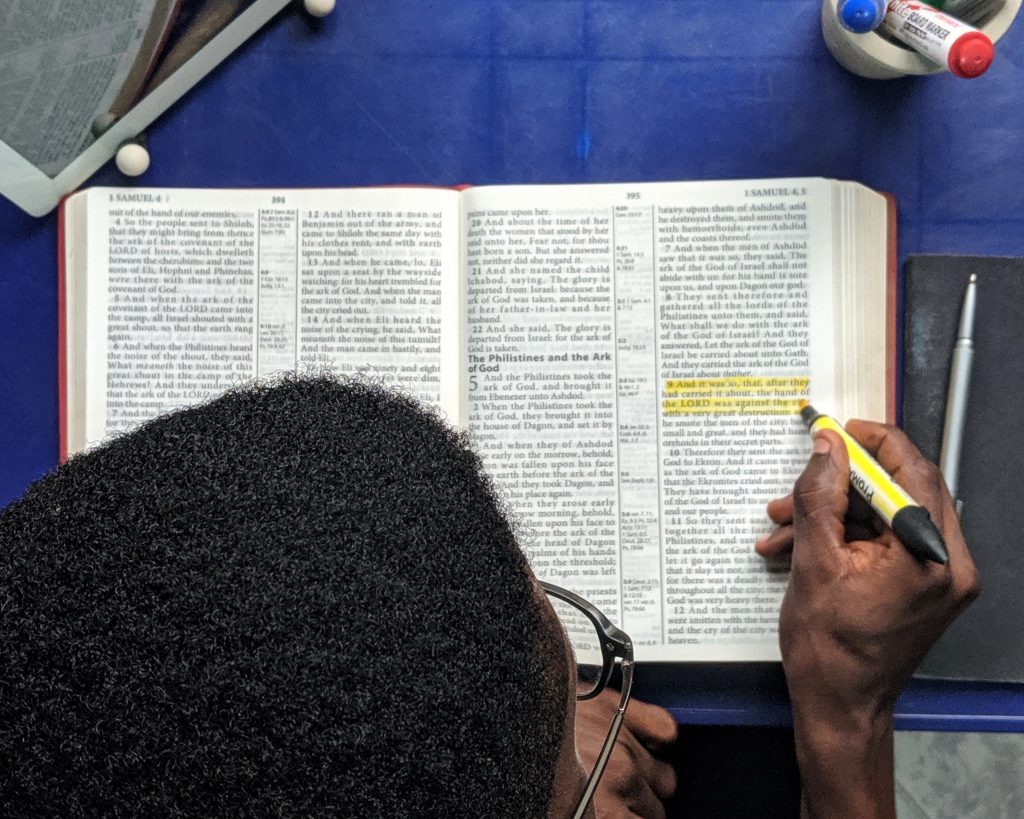
Isaac Calls on the Name of the Lord
Study Scripture: Genesis 26: 24 – 33
Background Scripture: Genesis 26: 1 – 33
Lesson 4 June 21, 2025
Key Verse
And he built an altar there, and called upon the name of the LORD, and pitched his tent there: and there Isaac’s servants dug a well.
Genesis 26:25
INTRODUCTION
What does the LORD God seek for in His children whom He has called and appointed to be pilgrims and strangers in this world, seeking a city which had foundation, whose builder and Maker is God?
What are the personality traits they should have and show, traits that we should note are pleasing to Him?
We will see some of the answers to the need for God-pleasing qualities in our lives. This Study Scripture will guide us as we seek to discover what God is looking for.
First, we should pay close attention to the fact that the main character in our Study is one of the Patriarchs, the child of promise born when Abraham was 100 years old and his wife Sarah was 90 years old.
Remember that you also are a child of promise, saved by the blood of Jesus, and hence much of the behaviour of Isaac and his move to his final resting place, the broad place found after his wanderings, are like your path in life and your behaviour.
He was the Patriarch who do not generally get patriarchal respect, either from the world, Bible believing scholars, from people I general, or from his family.
Does that ring a bell for you? Are you like that? Is that your experience?
The Patriarch Isaac lived in the shadow for his father Abraham who was great in the sight of God and as a powerful military leaders and wealthy shepherder was feared and respected. In 14 Chapters of the Book of Genesis we see those chapters were devoted to Abraham’s life, his activities and his starring role in salvation history. His role in the basis of our salvation is unquestionable.
Then we note the other well-known Patriarch Jacob, the son of Isaac starred in about 12 Chapters in the Book of Genesis. Isaac’s son Jacob was so important a figure that this son of Isaac had a name change, and his name was changed to Israel.
We therefore have a tendency to ignore or even disrespect Isaac in the few Chapters in which his role is dealt with. Only in Chapter 26 do we see a good treatment of this man.
Abraham his father seemed to have been willing to sacrifice him in a violent slaughter and Isaac the beloved son did not resist and went along with his father’s intentions.
Then we learn his beloved wife joined with her son Jacob to play a bad trick on Isaac. This however led to great suffering for her and her son Jacob who she never saw again when he had to flee for his life from his vengeful brother Esau.
In the Study Chapter however we see Isaac, though far from perfect, committing some of the same sins of his father, but always holding on to the God of his father, showing as Hebrews 11:20 emphasized that he was a man of great faith and was worthy to be counted among the stars of the heroes of faith.
In his life he faced the same problems that every believer of God will face.
But note that on his path to glory, despite his actions outside of the express will of God, his God whom he loved and cherished blessed him and made him get rest and peace, the peace, the quiet, the comfort, and respect of his neighbouring enemies for which he so longed for all his life.
This Study Chapter points out clearly to you that as one writer notes,
“There is help and hope in this passage for everyone who is walking the pilgrim’s path!”
We can learn of the value of being quiet and thoughtful in how we live.
We learn living in peace while surrounding by enemies, is a most important way to live. Proverbs 16:7 is most emphatic as it states:
“When a man’s ways please the LORD,
He makes even his enemies to be at peace with him”.
Note that this teaching from the Book of Proverbs is revealed in the life path of Isaac when Abimelech, the enemy, the leader of the vicious, lying, hostile, pagan Philistines came to set up a peace treaty.
Note also this faithful saying:
“Better is a little with righteousness,
Than vast revenues without justice”.
Note also how this applies to Isaac’s life and your life:
“A man’s heart plans his ways,
But the LORD directs his steps” .
Never forget the admonition of the Apostle Paul found in Romans 12:16-17
“Repay no one evil for evil. Have regard for good things in the sight of all men.
If it is possible, as much as depends on you, live peaceably with all men.
Beloved, do not avenge yourselves, but rather give place to wrath; for it is written,
“Vengeance is mine, I will repay” says the LORD”.
If you want a great, practical, and applicable way to a perfect life you will not find a better example than Isaac.
Note however this way of living might not get you much respect from those around you. Your friends, brethren in Christ, or your family might think because of your humbleness you are weak, foolish, or stupid.
But do not let them deter you from the best way of life, the way to live on the narrow way. Point them to the way Jesus lived. He had great power, great strength, but His attitude is depicted in Isaiah 43:5-6:
“A bruised reed He will not break,
And smoking flax He will not quench.
He will bring forth justice for truth.
He will not fail nor be discouraged”.
With the attitude of the Patriarch Isaac you can face problems at home and problems abroad.
God will appear to you, for the Holy Spirit lives inside you.
God will make your enemies, the Philistines who are around you, to come and beg you for peace with them.
They do this because they see that you know your God, and they see your God in you, and they know God is with you.
Life was not easy for Isaac, but it was the only way. He knew as the Lord Jesus taught, that the yoke of God was easy and His burden was light.
So, do not be afraid of conflict, but avoid conflict. Conflict will get you nowhere.
Understand the mercies of God.
As we examine the life of Isaac let us follow as one writer examines this false and much bandied about teaching and interpretation of generational curses. He explains the Scripture relating to this matter correctly:
“I want to talk about a problem that happens I think in Christendom. It is this idea that there are generationally curses. I don’t think that’s a biblical concept, not for Christians. So I want to explain to you where it comes from and what I think is the truth regarding this so that you understand this. Because some people believe that if my father (as in Abraham) sinned, then I as Isaac have a built-in problem that’s part of who I am and that’s why I sin. It comes from this verse in Exodus 20:4-6. This is the Ten Commandments where it says-
You shall not make for yourself an image in the form of anything in heaven above or on the earth beneath or in the waters below. You shall not bow down to them or worship them; for I, the Lord your God, am a jealous God, punishing the children for the sin of the parents to the third and fourth generation of them who hate me, but showing love to a thousand generations of those who love me and keep my commandments”.
It’s the those who hate me that people don’t see. But showing love to a thousand generations to those who love me and keep my commands.
So which are you? Are you the one who hates God or are you the one who loves God?
Well it depends.
That’s going to determine what happens here. You can’t say to yourself,
“Well because my parents or my grandparents sin then I then have this curse on me and I also sin in the same way’. No. You don’t say that. Not if you are a Christian.
It is true that parents influence their children. We know that children are more susceptible to smoking as a habit if one of their parents smoked. We know that children are more prone to act out in anger if they have an angry parent. If you had a parent who dealt with their famine or their struggle or their stress in life by yelling and cursing, you have a more of a tendency to do the same thing.
But the beauty is that when you accept Jesus Christ into your life, when you love God, and you keep His commands, when you do that then God blesses a thousand generations. Notice that. But showing love to a thousand generations of those who love me and keep my commands. Because when you become a Christian God breaks the chains of bondage and He builds into you this beautiful freedom that you can have to move forward in your life. It’s a beautiful thing that god wants to do in your heart and your life.
Abraham had an effect on his son. Many years later, of course, this takes place. But the story would have been told. Abraham told his story. It was passed on from generation to generation until Moses actually wrote it down. So Isaac heard the stories of what his dad did and he got into a tough situation here. The famine came, the stress points came. And when stress points come we go to solutions. Sometimes those solutions aren’t the best.
Well Isaac made a mistake”.
Notice therefore the importance of Context. Many of us ignore Context and do not look carefully at what Scripture is saying. Let us avoid that error.
Ezekiel 18 deals at length with the misinterpretation of the Exodus 20 statement by God. The prophet condemns the idea found in erring and unrepentant Israel that ‘the fathers had eaten sour grapes and because of that the children’s teeth are set on edge’.
In Jeremiah 31:29-35 that prophet added his condemnation of that excuse for continuing to sin, and then told Israel that because of their foolishness God would bring in the New covenant where their hearts would now be hearts of flesh. God would take out of them their hearts of stone.
With that teaching in Scripture let us look at Isaac as he was put to the test. Famine came. How would he respond?
THE TEXT
THE BACKGROUND. THE CONTEXT OF THE STUDY
Verses 1-22. Isaac had been living at Beerlahai-roi ‘a place meaning “well of the living one who sees”,
It was the oasis in the wilderness where Sarah’s servant Hagar had fled to when expelled from the house of Abraham. There she had learned that God would provide for her needs.
But in our Study a famine in the land forced Isaac to leave, following the path of Abraham his father who when famine came went from the Promised Land to Egypt.
There is a biblical connection between famine and faith. But Isaac had not seemed to have learned that God can care for His people in times of famine, and that difficult times are there to prove the powerful hand of God. So Isaac followed what Abraham had done and left for Egypt, travelling through the land of the Philistines. He seemed to have forgotten the promise given to Abraham that his descendants would inherit the land and live there forever.
God was faithful and no power, force, or famine could thwart that promise. But Isaac like Abraham left for Egypt. He behaved exactly like we do when pressure comes even though we know the promises of God and like to sing ‘He never failed me yet”.
We always find ourselves looking for alternatives to faith when bills mount, there is a money famine, or a love famine.
Note that there are generally famines in the life of a Christian. So we often find ourselves tempted to go to the world for solutions that we need.
Egypt was not as vulnerable to famine as Canaan was, for the great river Nile flowed from Ethiopia and the countries above it and watered Egypt, bringing and depositing fertile soil.
The attraction of Egypt was strong and desire for it had captured Abraham. The fears that plagued Abraham plagued Isaac so he headed toward Egypt. But as Isaac journeyed south God appeared to him, reminded him of the promises to Abraham and warned him not to follow his heart’s desire.
The covenant terms about the land promise, the multiplication of Abraham’s descendants, and the blessings promised to all the nations of the earth were repeated. God pointed Isaac to the need for faith and obedience to the commandments, statutes, charges and Laws of God.
So this man of faith stopped in Gerar, in the land of the Philistines and there to protect himself from the death that he thought would happen to him he lied that Rebecca was his sister. So much did he rely on the covenant promises!
It is quite possible that we will lie and will easily say God is not the all-powerful God of grace, compassion, pity, and mercy even after God had made us great promises. We too fear men and think our lies will protect us. But the men Isaac so feared discovered Rebecca was in fact Isaac’s wife and we see the incredible scene where he is rebuked by the pagan king just as his father had been rebuked years before by another pagan king. Isaac discovered that the men of Gerar that he thought, with some evidence, were thoroughly wicked, were more righteous than he.
They well knew the consequences of committing the sin of taking another man’s wife and committing adultery.
But nevertheless God blessed Isaac and the Philistines saw his prosperity and envied him. So Isaac left Gerar, worked hard, went further on the land his father had bought from the Philistines and had dug wells there. When he found water in the wells Abraham had dug, which the Philistines had plugged with earth, the Philistines harassed Isaac and falsely claimed the wells belonged to them.
But instead of fighting for what legally belonged to him, Isaac moved on leaving these beautiful wells behind.
Verse 22. The Patriarch finally move about 25 miles away from the harassing Philistines and dug a well at a place named ‘roominess’or (Rehoboth), acknowledging God’s faithfulness and blessing. God had made room for him so that he would be fruitful as promised.
You can imagine Isaac sighing finally there is room for us. God has taken these crazy people away from me so I can be myself and be at peace.
He had faced the problems with the world successfully because he saw God loved him and the hand of God was on him. They had kicked him out of their country and stolen the wells that belonged to Abraham and the new well he had found, but he was brought to the place of rejoicing.
See 1 Peter 4:12-16 for you encouragement.
Verse 23. Isaac then moved to Beersheba where he and his father had returned after the sacrifice on Mount Moriah. God had renewed the covenant with Abraham there and Isaac stayed there.
Verse 24. Note that God had appeared to Isaac when he was leaving for Egypt. Isaac then in obedience stopped in Gerar. But in that place he had faced many problems by evil and jealous people.
Now God had to appear to the Patriarch again that same night in Beersheba reminding him that He was the God of his father Abraham and so he should not fear.
The terms of the covenant with Abraham were recounted by God and therefore he did not have to fear the Philistine herdsmen or Abimelech. God in effect was telling Isaac to leave the Philistines with the wells that did not belong to them. They would not benefit and be at peace because of their ungodly actions.
Verse 25. Isaac promptly built an altar and called on the name of the Lord. Right away he dug a new well for like Abraham, the altar of worship and sacrifice and the tent showed a life of trust. Both together meant spiritual and material blessings were at hand.
So, let the world keep what it had stolen. It would not benefit them. Take note that the principles of God still applies for persons, and as well for nations, tongues, and tribes.
Verses 26-27. As one would expect eventually the pagan Philistines, their leader, their advisor, and their army commander came to Isaac.to make overtures of peace.
Isaac was not afraid of them but accosted them, asking why they had now come to him after they had kicked him out of their kingdom. They were not his friends. They hated him.
Isaac had thought he had finally gotten rid of these people so he questioned why they were now bothering him.
Verses 28-29. The response of these pagans is surprising. They admitted they had been watching Isaac and his people.
They had seen that his God had protected him, blessed him, and prospered him. One writer makes us know what they were really saying.
These pagans were not unaware of the existence of the Living Almighty God. God had never left Himself without a witness to all men for He is just and merciful. As the Apostle Paul said in Romans 1, men knew God but had supressed the knowledge of God from their hearts. They were thus all of them guilty before God. Sowe are told:
“When they said “Lord” they used the name of the God of Abraham, Isaac, and Jacob. “The Lord is with you; we see that plainly”.
That is what they said.
“How much hardship and pain Isaac could have caused if he had fought for his own rights.
I am sure he could have secured them: they were his by law, and he had the strength to take them by force.
But he refused to fight. He let God fight his battles for him, and God gave him what he wanted.
And in addition, he gave him the hearts of the unbelievers around him. Proverbs 16:7 says,
When a man’s ways please the Lord, he makes even his enemies to be at peace with him’.’
So the Philistines wanted a covenant with Isaac, an agreement that he would not attack or harm them. Abimelech claimed they had not touched Isaac (true they had not violated Rebecca), and that they had only done good to Isaac.
That of course was an outright lie.
But Isaac did not defend himself or insist that they admit they had done all kinds of wrong to him all the time he was with them.
They admitted they knew God was with Isaac. So Isaac was wise and knowing the ways of God he did not return evil for evil. He sought the provision of God.
Verses 30-31. Isaac agreed to no hostility on his part and they had the customary feasting together. Isaac made an oath with the Philistines and they left him departing in peace.
God gave Isaac what he longed for.
Verses 32-33. The very same day Isaac’s servants who had been searching for Abraham’s well there found it and Isaac called it “Beer-Sheeba” which means “the well of oath”.
They had found all the water their hearts desired and so they named the city Beersheba.
CONCLUSION
One writer reminds us that God has blessings waiting for Isaac and those blessings came because of the mercies of God.
It is not only believers that need mercy. Sinners need even more mercy than believers need. Sinners need mercy and we should never forget that and behave as if we can leave them alone in their sins without trying to help them and rescuing them from the pit of hell. One writer makes this important comment:
“There are spiritual laws that exist in the world. We know those as Christians because we are trying to learn them. You’re trying to learn them. We’re trying to apply them to life. But the assimilation of the spiritual laws doesn’t happen fast enough for me to meet the demands of the blessings I need from God.
You see I want more from God than what I’ve been able to learn and grow.
The difference between that is mercy.
My spiritual intelligence is not great enough yet to experience what I need in the blessing department and God wants to give me more.
So God gives me the blessing and the blessings are the mercy of God in my life…
All these blessings that God wants to provide for us come to us because of who God is. He wants to bless us.
Do you know why He does that? He blesses us because He wants us to see His goodness. He want us to be attracted to Him. He wants us to recognize that He is a good Father”.
There is a pointed lesson for fathers in this Study. They have to be very careful because the things they do will influence their children. The children are watching.
On the other hand children must be very careful for the things they do will not only influence their parents but they will affect their parents.
So note all need the mercies of God.
All have to learn to worship and to live as it were in a “tent” for believers are pilgrims and strangers marching through this world. This world we see and live in now is not the home of believers. They like Isaac and the other heroes of faith look for a city which had foundation, whose builder and maker is God.
So all believers must look around them at the world and see if their life is a source of blessing for those in the world.
Ask yourself if the world see something in you that distinguish you from them.
Do you have love, joy, peace, patience, thankfulness, and are walking the way Isaac came to walk and the way Christ walked?
Remember there are Philistines around you that are watching you and can learn from you. You have to walk like Isaac and influence them and not let them influence you to do evil.
Remember we all need the mercies of God and the tremendous blessing He has for men.
Let us put away fear. Isaac did and so can you.
The sad ending to this Chapter is that Isaac’s son Esau turned out to be profane. He did not respect the covenant of God. To him the birthright was considered as nothing valuable.
So we read about Esau marrying pagan women and their behaviour brought great pain to both Isaac and Rebecca.
So let us be very careful as we pilgrim through this world.
Let us as Isaac come to call upon the name of the LORD.
That means we should learn everything about Him and not resist the sanctification work of the Holy Spirit as He changes us in the image of the Lord.
Do not grieve Him.
You make sure you remember the Covenant and the blessing it brings.
You will find the Water of Life. You will have the sustaining Tree of Life God has provided.
God had provided His commandments, His Laws, His statutes.
In addition He had provided the blood of His only begotten Son which will keep on cleaning you from all unrighteousness.
He has given you the indwelling Holy Spirit. You have all you need for salvation and for entering Paradise.