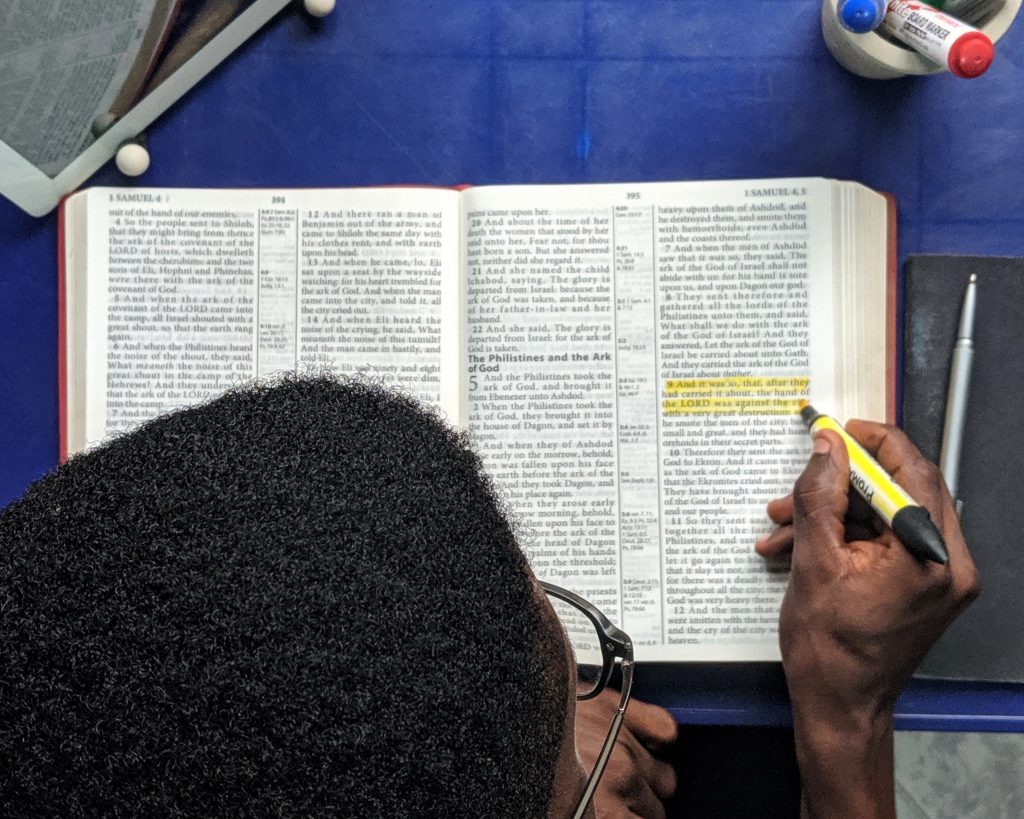
A GUIDED EXPOSITION
STEPHEN
Early Interpreter of Christianity
STUDY PASSAGES
Acts 6:7–10 • Acts 7:54–60
Background: Acts 6:1–7:60
Devotional Reading: Luke 23:32–43
KEY VERSE
“And Stephen, full of faith and power, did great wonders and miracles among the people.”
Acts 6:8, KJV
Lesson 10 • August 8, 2026
Adapted from a manuscript by Hugh Fyffe
Contents
Introduction……………………………………………………………………………………………. 3
The Church at a Crossroads………………………………………………………. 5
Stephen, Full of Grace and Power……………………………………….. 7
Before the Council: Stephen’s Defense…………………………….. 9
The Martyrdom…………………………………………………………………………………….. 11
Major Themes………………………………………………………………………………………….. 13
Practical Application…………………………………………………………………… 15
Conclusion………………………………………………………………………………………………… 16
Introduction
There was a time, in the ancient courts of the East, when the bearer of unwelcome news to a king might pay for that honesty with his life. Stephen, the central figure of this study, brought news that was anything but unwelcome — the good news of a Messiah who had come, died, risen, and ascended — and yet he met a fate not unlike the doomed messenger’s. His story asks us a question every generation of believers would rather avoid: do we have the will to tell others about Jesus Christ, even when the truth is not what they want to hear?
That question exposes several others beneath it. Do we lack knowledge of the gospel, or do we lack the will to share what we already know? Have we grown comfortable enough in our own faith that boldness feels unnecessary — more concerned, if we are honest, with our own reputation than with the reputation of the gospel we carry? Some of us hesitate because we are genuinely uncertain what we believe; others hesitate because we have quietly redefined love in a way that excuses our silence. If speaking the truth plainly seems unloving to us, we have perhaps confused love with the avoidance of discomfort — a confusion Stephen never allowed himself to make.
Scripture calls us to love our enemies and to pray for those who persecute us, and most of us know this well enough to recite it. Knowing it and living it, however, are different things, and the distance between them is exactly where Stephen’s example presses hardest. He never divided boldness from love; he showed that the two belong together. Luke records one small, striking detail marking the difference between Stephen and everyone around him: his face. Those who watched him on trial for his life said it looked “as it had been the face of an angel”[1] — not because he had ceased to be human, but because the Holy Spirit within him had already begun to shine through. The question the text leaves for us is uncomfortable and personal: if the world looked closely at us, would it see any difference at all?
The chapter and the questions it raises reach further still, into the very structure of the church — how its servants are to be chosen, what qualifies them, and how they are to regard themselves once chosen. These are not merely historical curiosities; they touch our own convictions about calling, character, and the Holy Spirit’s authority over the church’s life. If we sit with these questions honestly, we may find ourselves a little uncomfortable — not because Scripture is unclear, but because our practice so often runs ahead of, or behind, what the Spirit actually asks of us.
To understand what unfolds in Acts 6 and 7, we need to step back into the world in which the church was born. The long-promised Messiah had come, exactly as Isaiah had foretold,[2] and Israel — its people and its rulers alike — had rejected Him. He was crucified, suffering a death of calculated cruelty, after having wept over Jerusalem from the Mount of Olives and warned the nation of a season of sorrow that would not lift until it was ready to say, “Blessed is he that cometh in the name of the Lord.”[3] The author of this study lesson, reflecting on the prophecies of Daniel and Zechariah concerning Israel’s future, sees this ancient pattern of rejection still working itself out among the nations in our own day, and he asks us, with him, to do what Scripture instructs: pray for the peace of Jerusalem.[4]
Soon after the Feast of Pentecost, when the promised Holy Spirit fell exactly as the prophet Joel had foretold,[5] the book of Acts begins introducing figures beyond the original Twelve. Foremost among them is a gifted young expositor of the faith named Stephen — a man some Bible students have called “Paul before Paul.” He is introduced almost in passing, first on a list of seven men appointed to administer a food-distribution program for widows, yet within two brief chapters he becomes the young church’s first great apologist, and its first martyr.
The Church at a Crossroads
Stephen’s introduction to the biblical narrative begins with a problem, not a sermon. As the young Jerusalem church grew explosively after Pentecost, it quickly outgrew its administrative capacity, and the strain produced exactly what growth so often produces: friction between different groups of people. What had been, only weeks before, a small and largely homogeneous band of Aramaic-speaking believers now included Hellenistic Jews — men and women born outside Palestine, scattered throughout the Mediterranean world, who spoke Greek as their first language and had returned to Jerusalem in their later years, often to end their days and be buried in the holy city. Native-born “Hebrews” and returning “Hellenists” worshiped side by side, yet the old suspicions between the two groups had not vanished simply because both now followed Jesus.
One respected commentator on the book of Acts observes that Hebrews tended to regard Hellenists as compromisers who had grown too comfortable with Greek culture, while Hellenists in turn viewed Hebrews as holier-than-thou traditionalists — a mutual suspicion that Satan was quick to exploit.[6] Into this environment came a very practical complaint: the Hellenistic widows, dependent on the church’s daily distribution of food, were being overlooked in favor of the native Hebrew widows. It was, on the surface, an administrative failure. Beneath the surface, it was the first real test of whether the newborn church could hold together across the very lines of language and culture that divided everyone else in the Roman world.
The apostles’ response set a pattern worth noticing. They did not dismiss the complaint, nor did they take personal charge of fixing it themselves. Instead, they asked the whole community to select seven men — of good reputation, full of the Holy Spirit, and full of wisdom — to oversee the distribution, freeing the Twelve to give themselves entirely to prayer and the ministry of the word.[7] It is worth pausing over how little interest the apostles showed in controlling the process themselves. They trusted both the Spirit and the congregation enough to delegate real responsibility, and in doing so they modeled something the church has often struggled to relearn: that spiritual authority is not the same thing as administrative control.
Among the qualifications Scripture lists, one deserves particular note: the seven were to be men.[8] This requirement does not imply any inequality of spiritual standing between men and women in Christ — Paul would later write to the Galatians that in Christ Jesus “there is neither Jew nor Greek, there is neither bond nor free, there is neither male nor female”[9] — but it does establish, in the practice of the apostolic church, that this particular office of public, ordained leadership was reserved for men. God has used women mightily throughout the whole of church history, in ministries of every kind; the instruction here concerns the specific pattern of the church’s earliest ordained offices, not the value, gifting, or capability of women in the kingdom of God.
Among the seven chosen, one name is listed first: Stephen, described as “a man full of faith and of the Holy Ghost.”[10] No one could have foreseen, at the moment of his appointment to so practical a task, that within two chapters he would become the most formidable defender of the faith the young church had yet produced — nor that his death would scatter the gospel far beyond Jerusalem’s walls. Effective service for God, it turns out, is never measured by the length of one’s tenure but by the depth of one’s surrender to the Spirit.
Stephen, Full of Grace and Power
Luke summarizes the immediate fruit of this resolved conflict in a single verse: “And the word of God increased; and the number of the disciples multiplied in Jerusalem greatly; and a great company of the priests were obedient to the faith.”[11] Three things happened at once. The word of God spread more widely. The number of believers grew, because people recognized something real and honest in what they were hearing. And, most remarkably, a great number of priests — men whose livelihood depended on the very temple system that Jesus had come to fulfill — themselves became obedient to the faith. Having watched the church’s compassionate care for its widows at close range, and having offered sacrifices they now understood pointed toward Christ all along, many of them could no longer resist the evidence in front of them.
It is into this atmosphere of growth that Stephen steps fully into view. “And Stephen, full of faith and power, did great wonders and miracles among the people.”[12] Luke has already told us Stephen was full of the Spirit and of wisdom, and full of faith; now he is full of grace and power as well, performing signs that, up to this point in Acts, only the apostles themselves had been said to perform.[13] This is a significant detail. Stephen was not one of the Twelve. He had not walked with Jesus during His earthly ministry. Yet the same Spirit who empowered Peter and John to heal and to preach with boldness was now working with equal power through a man chosen only a short time before to wait on tables.
Stephen’s gifting did not go unopposed. “Then there arose certain of the synagogue, which is called the synagogue of the Libertines, and Cyrenians, and Alexandrians, and of them of Cilicia and of Asia, disputing with Stephen.”[14] This “Synagogue of the Freedmen” appears to have gathered Hellenistic Jews from several distinct communities — some descended from those taken captive to Rome and later freed, others from the great Jewish population of Alexandria in Egypt, and still others from Cilicia in Asia Minor, whose capital city, Tarsus, was the hometown of a brilliant young Pharisee named Saul.[15] It is entirely possible, though Scripture does not say so directly, that Saul himself stood among those who first tried and failed to out-argue Stephen — a foretaste of the far greater encounter still to come.
Whatever the exact makeup of the group, the outcome is stated plainly: “And they were not able to resist the wisdom and the spirit by which he spake.”[16] Stephen’s opponents were not defeated by superior rhetoric or clever argument; they were undone by a combination no merely human debater can counterfeit — a mind saturated with Scripture and a life yielded entirely to the Holy Spirit. The evident sincerity and conviction of a Spirit-filled witness will move hearers far more than the most polished argument delivered without genuine faith behind it. Stephen stands, in this sense, as perhaps the first great apologist of the Christian church — remarkable not because he had studied under the apostles, but because he had studied, deeply and diligently, the Scriptures that testified of Christ.
Before the Council: Stephen’s Defense
Unable to defeat Stephen in open debate, his opponents resorted to what honest argument could not achieve: false witnesses, secretly coached to accuse him of blasphemy against Moses, the law, and the temple.[17] Brought before the Sanhedrin — the same council that had condemned Jesus to death only a short time before — Stephen did not defend himself point by point. Instead, he did something far more daring: he retold the story of Israel from Abraham onward, letting the nation’s own sacred history become the evidence against his accusers.
He began with Abraham, called out of his own country toward a land and a promise he would not live to see fulfilled — a man whose entire life was reshaped by simple, obedient faith in the word of God. He moved to Joseph, sold into slavery by his own brothers, who was vindicated and exalted only after passing through years of suffering that made no sense at the time. He came finally to Moses, rejected by his own people at his first appearance among them, yet raised up by God as their deliverer despite that rejection — a man who, Stephen pointedly reminded his hearers, needed forty years in the wilderness before he learned to depend on the Spirit of God rather than on the wisdom of Egypt he had once prized so highly.
Each figure told the same story from a different angle: God’s chosen deliverers are rejected the first time, and only later recognized. Stephen’s hearers could not have missed the implication. Moses himself had promised that God would one day raise up a prophet like himself, whom the people must hear;[18] Stephen’s entire sermon builds toward the conclusion that this promised prophet was Jesus of Nazareth — rejected at His first coming exactly as Moses and Joseph had been, and exalted by God despite, and even through, that rejection.
Stephen also confronted the accusation concerning the temple. Israel’s history, he argued, showed that God had never been confined to a building. The patriarchs worshiped Him with no temple at all; Moses received “the lively oracles” of God on a mountain, not in a sanctuary;[19] and even after the temple was built, the nation repeatedly turned to idols within its very shadow. God, Stephen insisted, does not dwell in houses made with human hands — a truth Isaiah himself had already declared.[20] For a council that had made the temple almost an idol in itself, this was not merely an academic point. It went to the heart of what true worship actually requires.
Stephen then turned the history he had recounted directly upon his accusers: “Ye stiffnecked and uncircumcised in heart and ears, ye do always resist the Holy Ghost: as your fathers did, so do ye. Which of the prophets have not your fathers persecuted? and they have slain them which shewed before of the coming of the Just One; of whom ye have been now the betrayers and murderers: who have received the law by the disposition of angels, and have not kept it.”[21] The pattern he had traced through Abraham, Joseph, and Moses now closed on the council itself. As one commentator has summarized the force of the charge, Stephen’s essential point was unmistakable: as Israel had always been, so this generation now stood revealed to be — betrayers, this time, of the very Messiah the whole of their Scriptures had promised.[22]
The Martyrdom
“When they heard these things, they were cut to the heart, and they gnashed on him with their teeth.”[23] Stephen’s words landed exactly where truth always lands on a heart unwilling to receive it — not as information to be weighed, but as an accusation to be resented. The council’s fury was, in the end, directed at God Himself, though it fell in that moment on the man standing in front of them. Jesus had elsewhere described the anguish of the lost in similar terms, as weeping and gnashing of teeth;[24] here the gnashing had already begun, long before the weeping would follow.
Against that fury, Luke sets a striking contrast: “But he, being full of the Holy Ghost, looked up stedfastly into heaven, and saw the glory of God, and Jesus standing on the right hand of God, and said, Behold, I see the heavens opened, and the Son of man standing on the right hand of God.”[25] While the council raged, Stephen’s eyes were fixed on heaven rather than on the mob before him. Scripture elsewhere describes Jesus as seated at the right hand of the Father;[26] here, uniquely, He is seen standing. Commentators have long puzzled over exactly what this means, and the wisest counsel is to resist speculating beyond what the text plainly says.[27] What can be said with confidence is that the image conveys something of profound comfort: Jesus rising, as it were, in solidarity with His suffering servant — offering, some have suggested, a kind of welcome fitting for the man who was about to become the first martyr among all who would ever follow Him.[28]
“Then they cried out with a loud voice, and stopped their ears, and ran upon him with one accord, and cast him out of the city, and stoned him.”
— Acts 7:57–58a, KJV
Luke’s language recalls the frenzied stampede of the Gadarene swine in Mark’s Gospel[29] — a comparison that captures just how completely reason had given way to mob fury. In their rage, the council abandoned even the pretense of legal process. Roman law reserved capital punishment to Rome alone, yet this crowd, blinded by fury, executed Stephen according to Jewish law without a second thought for the consequences that would follow from Rome.
Luke adds one detail that seems almost incidental at the time, yet proves to be the hinge on which the rest of the book of Acts turns: “and the witnesses laid down their clothes at a young man’s feet, whose name was Saul.”[30] This is our first introduction to the man who would become the apostle Paul. He stood that day as a kind of overseer to an act of mob violence — consenting to Stephen’s death, guarding the coats of the men who threw the stones, guilty by his own later admission of complicity in murder.[31] No one watching that day could have imagined that this same Saul would, within a few short years, become the greatest missionary the church has ever known.
Stephen’s final words complete the portrait Luke has been drawing throughout these two chapters: “And they stoned Stephen, calling upon God, and saying, Lord Jesus, receive my spirit. And he kneeled down, and cried with a loud voice, Lord, lay not this sin to their charge. And when he had said this, he fell asleep.”[32] Both prayers echo words Jesus Himself spoke from the cross — the commending of His spirit into God’s hands, and the plea for forgiveness on behalf of His killers.[33] Stephen’s trust in Christ never wavered, in life or in the act of dying; he was persuaded, to the very end, that Jesus would receive him. And Luke’s tender description of his death — he “fell asleep” rather than simply “died” — captures exactly what the New Testament everywhere teaches about the death of a believer: not an ending, but a rest, awaiting the resurrection.
Stephen’s dying prayer for his murderers may well have made its deepest impression on the very man overseeing his death. Scripture never states outright that Stephen’s prayer caused Saul’s conversion, but the juxtaposition Luke provides is too pointed to be accidental, and the church has long recognized in it the first quiet working of grace toward the apostle who would carry the gospel to the Gentile world. The death of the first martyr became, in other words, the doorway through which the church’s greatest missionary would eventually walk. Paul himself, writing years later, never seems to have forgotten the scene he witnessed that day outside Jerusalem’s walls.
Major Themes
Christ, the Fulfillment of Every Promise
Stephen’s entire defense before the council rests on a single conviction: that the whole of Israel’s Scripture — the promise to Abraham, the story of Joseph, the deliverance through Moses, even the law and the temple themselves — points forward to Jesus Christ. He does not treat the Old Testament as a separate story from the gospel; he treats it as the gospel’s own beginning. Every rejected deliverer in Israel’s history prepares the way for understanding the greatest rejection of all, and every eventual vindication prepares the way for understanding Christ’s resurrection and exaltation. To read Scripture as Stephen read it is to read every page of it as leading toward the same destination: “neither is there salvation in any other: for there is none other name under heaven given among men, whereby we must be saved.”[34]
The True Temple
Stephen’s teaching that God does not dwell in buildings made with human hands carries a pointed application for every generation of believers, including our own. It is not the church buildings we construct and maintain that constitute the true temple of God — it is the people in whom His Spirit dwells.[35] To transfer our devotion from the living God to the physical structures we build in His name is to risk exactly the kind of misplaced worship Stephen warned against. We are the temple; we are called to treat that temple — our own bodies, our own hearts — as consecrated to God, offering ourselves as spiritual sacrifices rather than resting our confidence in buildings, however beautiful.
Boldness Under the Spirit’s Control
Being filled with the Holy Spirit, as Stephen’s life demonstrates, is not a mystical or emotional experience detached from character and conduct. It looks like a specific, recognizable pattern: wisdom rooted in Scripture, grace toward others, and — when the moment requires it — unflinching boldness in speaking the truth, whatever the personal cost. Stephen was no superman; Luke gives us no indication of extraordinary natural gifts beyond what any faithful believer might possess. What set him apart was simple surrender to the Spirit’s control, and that same surrender remains available, and is expected, of every believer today.
Forgiveness That Mirrors Christ
Perhaps nothing in Stephen’s story is more remarkable than his final prayer. Facing the very men who were killing him, he did not curse them; he interceded for them, exactly as his Lord had done from the cross. This is not a forgiveness Stephen worked up through sheer willpower in his final moments — it is the fruit of a life already so shaped by the Spirit that Christlike love was simply what remained when everything else was stripped away. It stands as the clearest evidence in the whole account that Stephen truly was, as Luke says, “full of the Holy Ghost.”
Practical Application
Stephen’s story confronts every reader with a question that no amount of theological reflection can fully soften: do we have the will to tell others about Jesus Christ, even when doing so risks our comfort, our reputation, or our relationships? Many of us already possess the knowledge we need. What we lack, if we are honest, is not information but resolve — the same boldness the apostles prayed for and received,[36] and the same boldness Stephen displayed before a hostile council that held the power of life and death over him.
We might also ask ourselves whether we have quietly redefined love in a way that excuses our silence. It is possible to convince ourselves that speaking the truth plainly is somehow unloving, when in fact Scripture never separates love from truth-telling — it unites them.[37] Stephen loved the very men who stoned him enough to pray for their forgiveness even as they were killing him. That is not the behavior of a man indifferent to others’ feelings; it is the behavior of a man who understood that real love sometimes requires saying hard things, and always requires forgiving those who reject them.
Finally, Stephen’s example asks whether we have confused the temple of stone and mortar with the temple God actually desires — our own consecrated lives. It is easy to admire a building; it is harder, and more costly, to offer ourselves daily as living sacrifices, full of grace and power, ready to be used however the Spirit chooses. The measure of a faithful life, Stephen’s brief ministry reminds us, was never how long he served, but how completely he yielded himself to God in the time he was given.
Conclusion
Stephen’s teaching, taken as a whole, leaves the reader with an unavoidable claim: Christ is the fulfillment of everything Moses and the prophets promised, and to stand apart from Him is to stand apart from the God those Scriptures reveal. If we find ourselves out of step with what Stephen so plainly proclaimed, Scripture leaves us only one remedy — to repent, and to place ourselves under the gracious and merciful hand of the living God.
Stephen’s death brought the first phase of the church’s expansion in Jerusalem to a close, and scattered the believers — and with them, the gospel itself — into Judea, Samaria, and beyond.[38] His forgiving spirit toward his executioners mirrored the forgiving spirit of Jesus on the cross, and it remains the standard to which every believer who suffers for the faith is called. We do not know why God permitted so gifted and faithful a servant to be cut down so young. We do know that God is able to work even the sorrow of a martyr’s death toward a far greater good — for Stephen’s own prayer, we may believe, helped soften the heart of the young man guarding the executioners’ coats, setting in motion the conversion that would carry the gospel to the nations.
Stephen has taught us the gospel; the apostle Paul and the other apostles who followed would go on to elaborate, expand, and clarify that same gospel throughout the rest of the New Testament, leaving us without excuse if we choose to ignore or defy what has been so clearly given. We are called, as Stephen was, to be faithful to God and to follow His truth always — remembering always that we ourselves are the temple of the living God, and holding fast, as our closing word, to the ancient prayer of the Psalmist.
“One thing have I desired of the LORD, that will I seek after; that I may dwell in the house of the LORD all the days of my life, to behold the beauty of the LORD, and to enquire in his temple.”
— Psalm 27:4, KJV
[1]Acts 6:15 (KJV).
[2]See Isaiah 52:13–53:12.
[3]Cf. Matthew 23:37–39; Luke 19:41–44.
[4]Psalm 122:6. The source manuscript’s reflection on unfolding world events has been rendered here as the author’s own devotional perspective, consistent with editorial practice for passages of a speculative or interpretive nature.
[5]Joel 2:28–32; cf. Acts 2:16–21.
[6]David Guzik, Enduring Word Bible Commentary, “Acts 6” (enduringword.com). The source manuscript reproduced this commentator’s observations without attribution; the wording here has been paraphrased and the source credited.
[7]Acts 6:2–4.
[8]Acts 6:3.
[9]Galatians 3:28 (KJV).
[10]Acts 6:5 (KJV).
[11]Acts 6:7 (KJV).
[12]Acts 6:8 (KJV). The source manuscript rendered this verse “full of grace and power … performing great wonders and signs,” reflecting a modern paraphrase (cf. NASB); the King James wording, “full of faith and power … great wonders and miracles,” is restored here per the translation standard established for this series.
[13]Cf. 2 Corinthians 12:12 (KJV): “Truly the signs of an apostle were wrought among you in all patience, in signs, and wonders, and mighty deeds.”
[14]Acts 6:9 (KJV).
[15]Cf. Acts 9:11; 21:39.
[16]Acts 6:10 (KJV).
[17]Acts 6:11–14.
[18]Deuteronomy 18:15, 18; cf. Acts 3:22; 7:37.
[19]Acts 7:38 (KJV): “the lively oracles.” The source manuscript’s “living oracles” reflects a common modern paraphrase; the King James wording is restored here.
[20]Isaiah 66:1–2; cf. Acts 7:48–50.
[21]Acts 7:51–53 (KJV).
[22]Cf. David Guzik, Enduring Word Bible Commentary, “Acts 7” (enduringword.com), summarizing Stephen’s charge in substance as, “As Israel was in its history, so you are today.” The source manuscript’s paraphrase of this observation is credited to Guzik here.
[23]Acts 7:54 (KJV).
[24]Cf. Matthew 8:12; 13:42; 25:30.
[25]Acts 7:55–56 (KJV).
[26]Matthew 26:64; Colossians 3:1.
[27]David Guzik, Enduring Word Bible Commentary, “Acts 7”: “It is difficult to describe exactly what Stephen saw … going beyond the plain description of the text is pure speculation.” The source manuscript reproduced this observation without attribution; it is credited here.
[28]Cf. Guzik, ibid., who suggests Jesus may be pictured here as standing in solidarity with Stephen, and even offering a kind of welcome befitting his unique place as the first Christian martyr. The source manuscript’s language on this point closely follows Guzik and is credited accordingly.
[29]Cf. Mark 5:13.
[30]Acts 7:58b (KJV).
[31]Cf. Acts 8:1; 22:20.
[32]Acts 7:59–60 (KJV).
[33]Cf. Luke 23:34, 46.
[34]Acts 4:12 (KJV).
[35]Cf. 1 Corinthians 3:16; Romans 12:1.
[36]Acts 4:29–31.
[37]Cf. Ephesians 4:15.
[38]Acts 8:1, 4.